
Why would heart rate tell you anything about the brain?
Because the brain influences the heart in real-time. When an experience matters, the brain releases oxytocin into the bloodstream at the same moment it acts inside the brain. Oxytocin binds to the vagus nerve and to receptors concentrated in the heart and changes the heart's rhythm. The Immersion SDK measures that response from whatever cardiac sensor your app reads and turns it into two scores: Value, how important an experience is to the person, and Psychological Safety, how comfortable the person is.
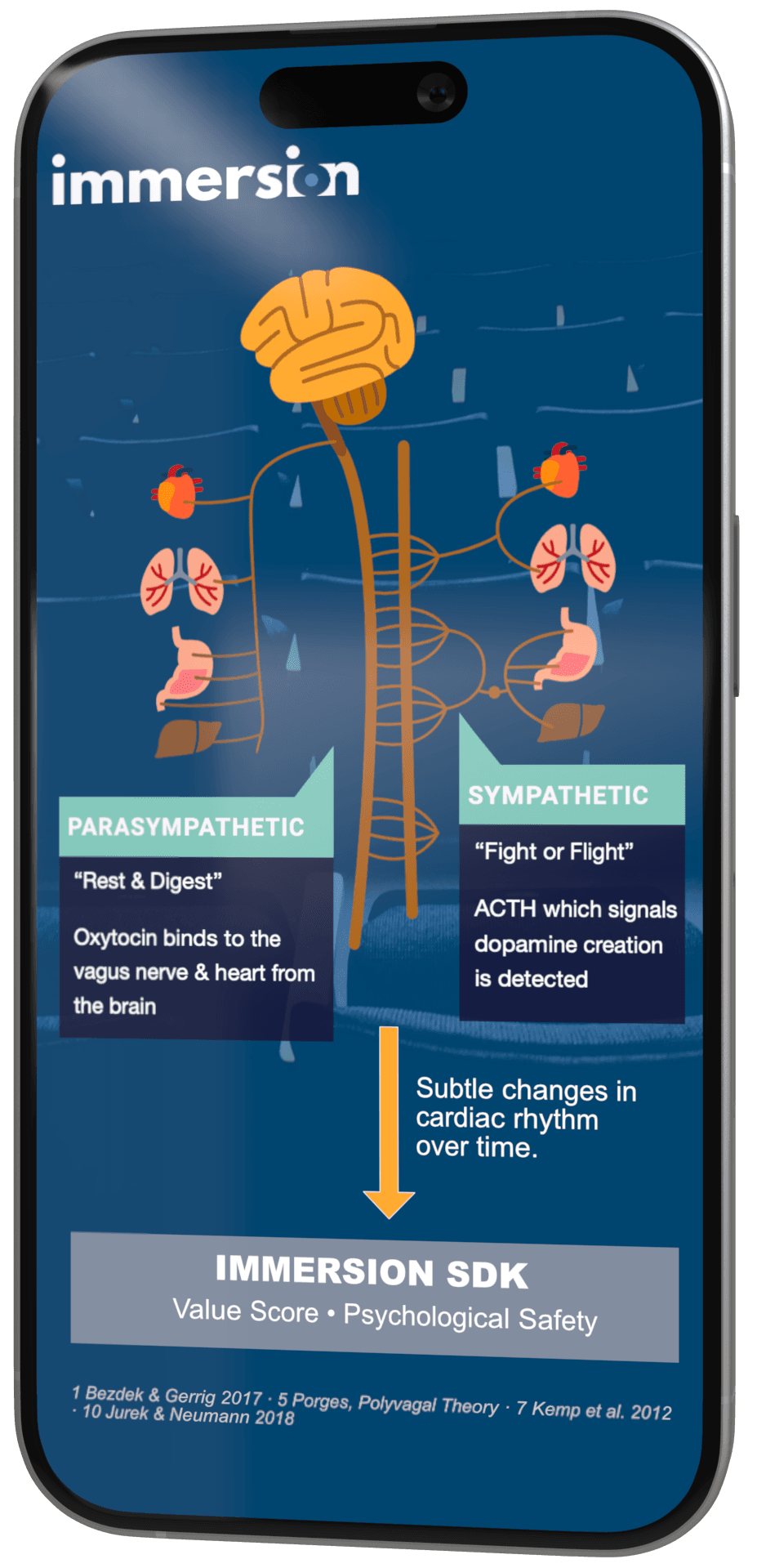
When an experience matters to us, the brain releases oxytocin, both inside the brain and, via the pituitary gland, into the bloodstream. The release is simultaneous, which is why a change in oxytocin in the blood reflects the activity of oxytocin in the brain.1–4
In the bloodstream, oxytocin binds to the vagus nerve and to receptors concentrated in the heart, subtly changing the heart's rhythm.7–11 At the same time, the sympathetic branch of the nervous system carries the stress response, an independent signal of arousal and attention, to the same organ.
Together these two branches of the autonomic nervous system leave a fingerprint in heart activity, second by second.5,6 Our founding team measured the central and peripheral nervous systems simultaneously at high frequency to map that fingerprint, then confirmed the pathways with synthetic-oxytocin infusion studies.
The result is two 0–100 scores the Immersion SDK computes from heart rate alone: Value, how important the experience was to the person, and Psychological Safety, how comfortable the person was while it happened. No lab, no electrodes, no brain scan, no self-report. A prediction engine, not an emotion-recognition system.
Twenty years of work sits behind two numbers.
Our founding team has spent much of the last twenty years measuring brain activity to predict when an experience will move someone to act. That research established oxytocin and dopamine as the neurochemical signals that the brain values an experience, and that the experience will motivate a decision.
- 01
Measure both systems at once
The team recorded the central and peripheral nervous systems simultaneously, at high frequency, to establish the relationship between what the brain is doing and what the body reports about it.
- 02
Establish cause, not correlation
Once the correlation was understood, synthetic-oxytocin infusion studies tested the causal role of the neurochemical in the body and confirmed that it influenced behavior.
- 03
Find the signal in the rhythm
Medical-grade instruments, read second by second, isolated the subtle changes that together signal neurologic value and, more importantly, predict what a person does next. That signal became Value, which predicts memory and behavior with 85–98% accuracy.
- 04
Leave the lab
PPG sensors in the wearables people already own, an Apple Watch among them, capture enough data second by second to make the expensive equipment unnecessary. That is what the Immersion SDK reads today.
- A physiological signal, not an inference from behavior.
The score comes from what the nervous system is doing, not from taps, dwell time, or a survey.
- Ordinary hardware.
Any accurate cardiac source at about 1 Hz will do: a watch, a BLE chest strap, a sport shirt, smart glasses, a finger sensor, even reflected-RF sensing. Your app supplies the raw inputs; the Immersion SDK asks for no permission of its own.
- Predictive, and validated.
Value has been shown to predict memory and behavior with 85–98% accuracy across dozens of studies and customer deployments.
- Not emotion recognition, not medical.
Value and Safety predict behavior. They aren’t diagnoses, not a measurement of nervous-system activity, and not a claim about named feelings.
- Bezdek & Gerrig (2017), Media Psychology; Gordon, Ciorciari & van Laer (2018), European Journal of Marketing
- Mar & Oatley (2008), Perspectives on Psychological Science
- Gabriel & Young (2011), Psychological Science
- Dal Cin, Zanna & Fong (2004); Green & Brock (2000), Journal of Personality and Social Psychology
- Porges, The Polyvagal Perspective (2007), Biological Psychology
- Thayer et al. (2009), the neurovisceral integration perspective, Annals of Behavioral Medicine
- Kemp et al. (2012), oxytocin increases HRV in humans at rest, PLOS ONE
- Norman et al. (2011), oxytocin increases autonomic cardiac control, Biological Psychology
- Barraza et al. (2015), The Heart of the Story: peripheral physiology during narrative exposure predicts charitable giving, Biological Psychology
- Jurek & Neumann (2018), the oxytocin receptor, Physiological Reviews
- Gutkowska & Jankowski (2012), oxytocin revisited: its role in cardiovascular regulation, Journal of Neuroendocrinology
- Barraza, Hu, Terris, Wang & Zak (2021), oxytocin increases perceived competence and social-emotional engagement with brands, PLOS ONE
- Merritt, Krouse, Alogaily & Zak (2022), continuous neurophysiologic data accurately predict mood and energy in the elderly, Brain Sciences
- Merritt & Zak (2024), continuous remote monitoring of neurophysiologic Immersion accurately predicts mood, Frontiers in Digital Health
- Rancati, Ghosh, Barraza & Zak (2025), the contagion of neurologic Immersion predicts retail purchases, Frontiers in Neuroscience
Isn't this just HRV?
No. HRV summarizes stress versus recovery over minutes and can’t tell an important moment from a boring one. The Immersion SDK decodes what’s riding on the rhythm, every second, into two scores that predict behavior.
Heart rate vs HRV vs ImmersionWant the full story?
The research program, the published studies, and how Value Measurement is used beyond the Immersion SDK live on the main Immersion site.
Related
All guides- Heart rate vs HRV vs ImmersionWhat each metric can and can’t tell you, with five worked moments.
- How do I measure emotion in my app?Five ways to do it. Four make you liable for something. One doesn’t.
- Immersion vs facial codingBiometric identifier plus emotion recognition.
- Immersion vs voice prosodyVoiceprint plus emotion recognition.
- Immersion vs HRVHealth data plus emotion recognition, without the science.
- Immersion vs surveysLawful, simple, and late.